AI Governance Workshop: ‘AI and the Future of Global Governance’

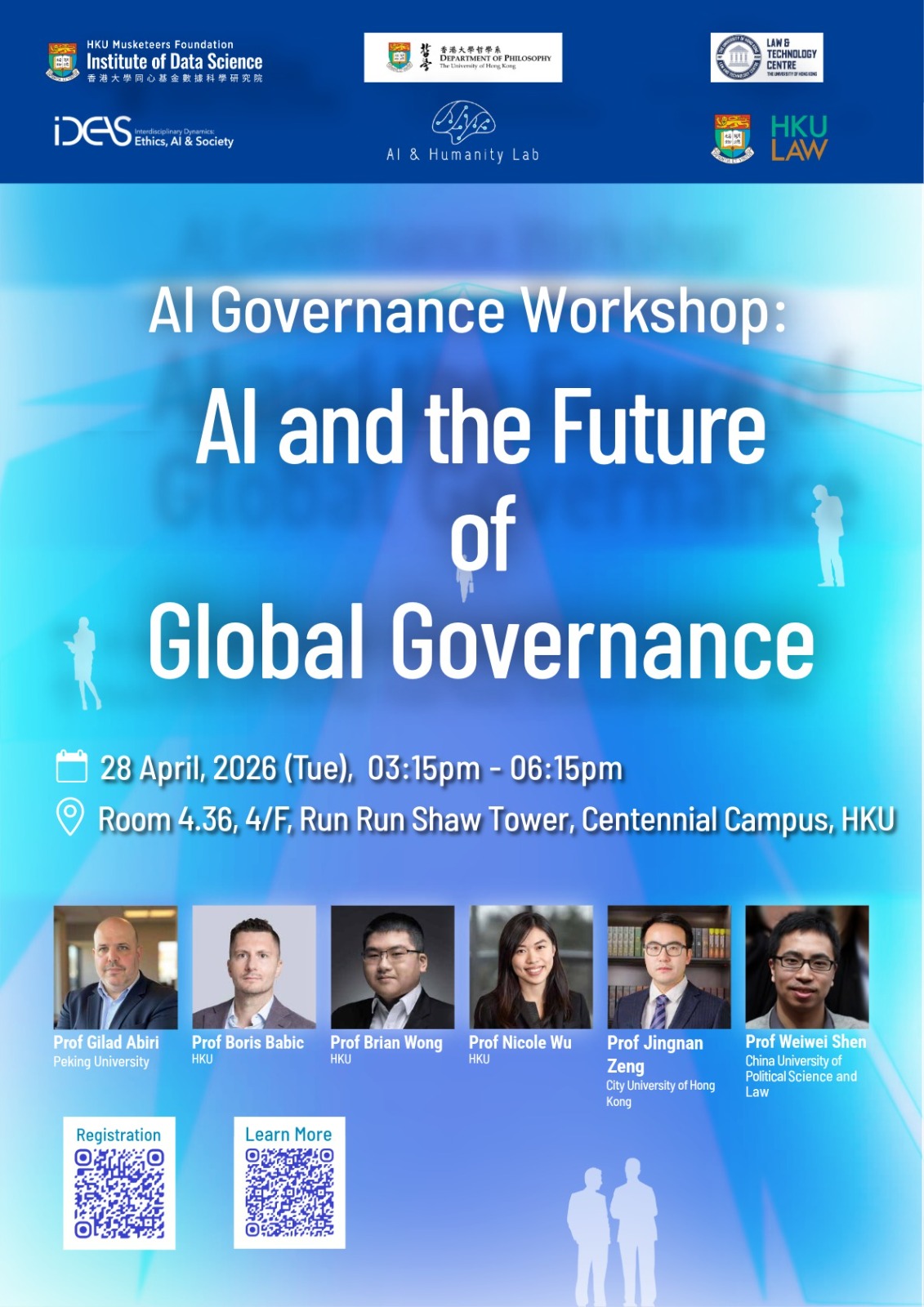
This workshop brings together scholars across philosophy, law, and international relations to examine how artificial intelligence is reshaping global governance. Discussions will explore the epistemic, behavioural, and geopolitical dimensions of AI, with a focus on how governance frameworks may need to evolve in response.

Programme

Time
Programme
Speakers
15:15 - 15:25
15:30 - 16:00
Epistemic Subordination
Prof Gilad Abiri, Peking University
Abstract:

Generative AI does not merely produce biased outputs. It encodes the majority's way of knowing as the default infrastructure of knowledge itself. We call this epistemic subordination. The training process compresses the full breadth of human expression into a single probabilistic model whose statistical baseline reflects the languages, assumptions, and cultural frameworks of the dominant culture. Minority epistemologies are not excluded but absorbed — present in the training data, yet structurally subordinated in the output. The result is not a collection of discrete biases that can be audited and corrected. It is an epistemic condition embedded in the architecture from which all outputs emerge. This unified harm cuts across three legal domains — anti-discrimination law, cultural and linguistic rights, and democratic viewpoint pluralism — and each fails to address it for the same structural reason: existing law regulates downstream, at the level of decisions and applications. The remedy must match the site of harm. If epistemic subordination is produced at the level of model training, then law must learn to govern at that level.
16:00 - 16:30
The Truth We Prompt: How User Partisanship Shapes AI interactions
Prof Nicole Wu, HKU
Abstract:

The rapid rise of artificial intelligence (AI) is not only transforming societies but also redefining the very foundations of international relations. Around the world, governments are racing to secure technological leadership, framing AI as both an economic opportunity and a strategic imperative. China has declared its ambition to become an AI superpower by 2030, while the United States is equally determined to safeguard its global dominance. These competing trajectories have intensified the AI race, driving technological decoupling and placing U.S.–China relations at the heart of the struggle for global order. This talk will explore the complex interplay between AI and geopolitics. It will examine how the AI race is accelerating strategic rivalry, fuelling pressures for decoupling, and creating new fault lines in global governance. Beyond competition, it will consider how AI may reshape the balance of power, challenge existing international institutions, and ultimately reconfigure the future world order. By analyzing the opportunities and risks embedded in this technological revolution, the talk highlights why AI has become one of the defining forces shaping our collective future.
16:30 - 16:45
Break
16:45 - 17:15
Prof Boris Babic, HKU & Prof Brian Wong, HKU
17:15 - 17:45
Prof Weiwei Shen, China University of Political Science and Law
17:45 - 18:15
AI, Geopolitics, and the Future World Order
Prof Jingnan Zeng, City University of Hong Kong
Abstract:

The rapid rise of artificial intelligence (AI) is not only transforming societies but also redefining the very foundations of international relations. Around the world, governments are racing to secure technological leadership, framing AI as both an economic opportunity and a strategic imperative. China has declared its ambition to become an AI superpower by 2030, while the United States is equally determined to safeguard its global dominance. These competing trajectories have intensified the AI race, driving technological decoupling and placing U.S.–China relations at the heart of the struggle for global order. This talk will explore the complex interplay between AI and geopolitics. It will examine how the AI race is accelerating strategic rivalry, fuelling pressures for decoupling, and creating new fault lines in global governance. Beyond competition, it will consider how AI may reshape the balance of power, challenge existing international institutions, and ultimately reconfigure the future world order. By analyzing the opportunities and risks embedded in this technological revolution, the talk highlights why AI has become one of the defining forces shaping our collective future.

HKU to Host Global AI Governance Summit Bringing Together Leading Voices Beyond US–China Binary

HKU to Host Global AI Governance Summit Bringing Together Leading Voices Beyond US–China Binary

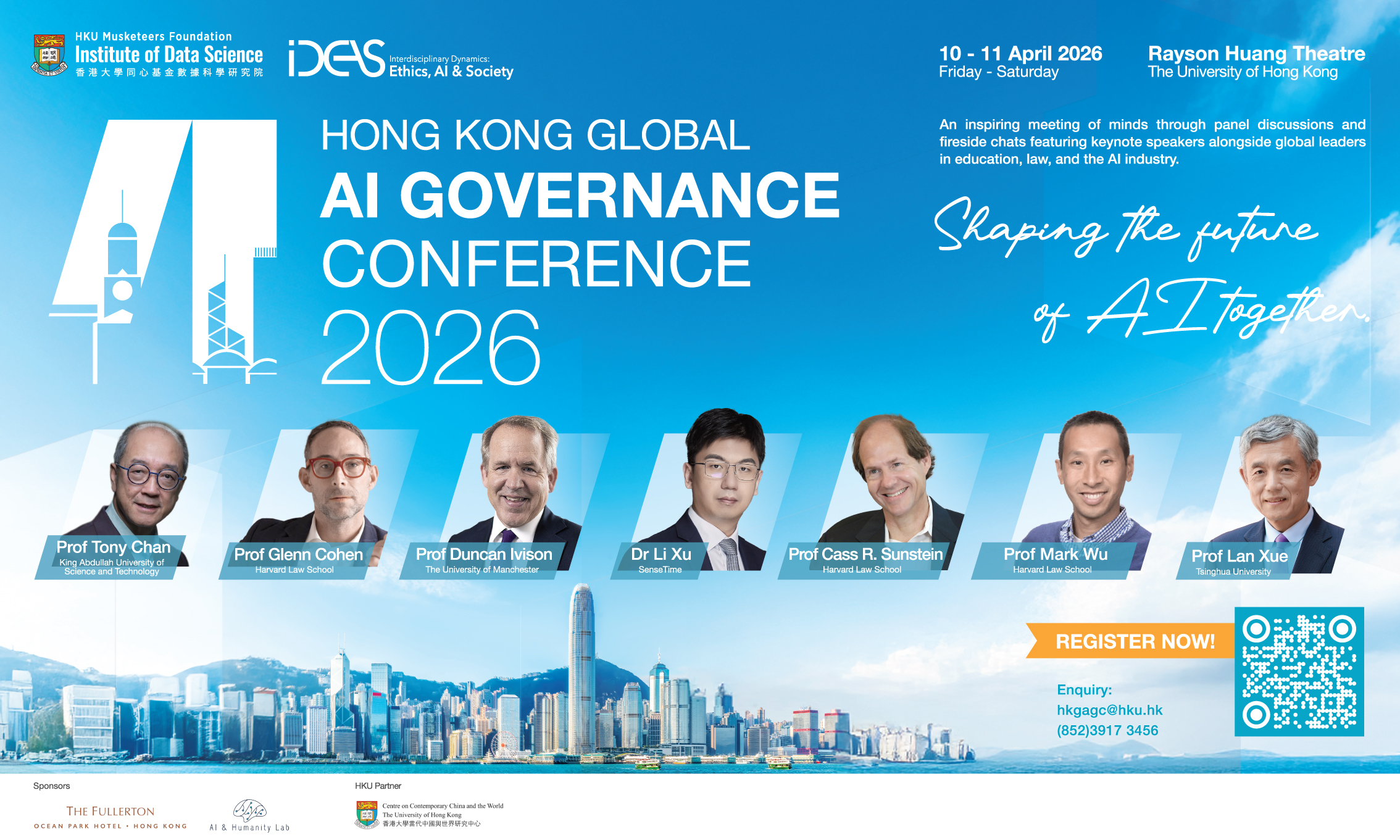
The HKU Musketeers Foundation Institute of Data Science (HKU IDS) at the University of Hong Kong will host the Hong Kong Global AI Governance Conference 2026 on 10–11 April at the Rayson Huang Theatre.

The Summit will convene leading scholars, policymakers, and industry figures from across Asia, Europe, and North America to address one of the most pressing questions in artificial intelligence today: how global AI governance can evolve beyond a narrow focus on major power competition.

As debates on AI regulation are increasingly shaped by geopolitical tensions, the Conference aims to broaden the conversation by incorporating perspectives from regions and communities that are often underrepresented in global policymaking.

Organised under HKU IDS’ Interdisciplinary Dynamics, Ethics, AI & Society (IDEAS) initiative, the Summit reflects Hong Kong’s position as a bridge between East and West, and between technological innovation and policy dialogue.

The two-day programme will feature keynote dialogues, fireside conversations, and panel discussions spanning AI and education, conceptual foundations of AI, legal and regulatory frameworks, public governance, and international cooperation.

Confirmed speakers include Dr Li Xu (SenseTime), Professor Tony Chan (King Abdullah University of Science and Technology), Professor Duncan Ivison (University of Manchester), Professor Lan Xue (Tsinghua University), Professor Cass Sunstein (Harvard Law School, via video contribution), and Professor Mark Wu (Harvard Law School), alongside senior figures from global policy institutions.

Professor Yi Ma, Director of HKU IDS, said:

“Artificial intelligence is transforming societies and institutions at an unprecedented pace. Addressing its challenges requires collaboration across disciplines and regions.”

Professor Herman Cappelen, Chair of the Conference Organising Committee and Director of IDEAS, added:

“This is not just another AI conference. It is a conversation the world needs right now.”

Further details: https://ideas.hku.hk/hkgagc2026/

For enquiries, please contact:

Jimmy Kwok

Executive Officer

HKU Musketeers Foundation Institute of Data Science

Email: jimmyk@hku.hk | Tel: (852) 3917 2323

About HKU Musketeers Foundation Institute of Data Science

Established in 2021, HKU IDS is a cross-disciplinary research institute dedicated to advancing data science and AI research, with a focus on Fundamental Data Science, Explainable AI and Human–Machine Interactions, and Smart Society.

More details about the Institute are available at: https://datascience.hku.hk/


Epistemic opportunities: AI Systems as Cognitive Scaffolding

Collaboration with AI & Humanity Lab

Epistemic opportunities: AI Systems as Cognitive Scaffolding

Date: December 7, 2024 (Saturday)

Time: 13:00 – 15:00

Venue: Rm 10.13, Run Run Shaw Tower, Centennial Campus, The University of Hong Kong

Registration: here

Speaker: Dr Henry Shevlin, University of Cambridge

Chair: Dr Frank Hong, The University of Hong Kong

Organizers: AIH Lab and IDEAS-IDS

Abstract:

Recent rapid progress in artificial intelligence has prompted renewed interest in the possibility of consciousness in artificial systems. This talk argues that this question forces us to confront troubling methodological challenges for consciousness science. The surprising capabilities of large language models provide reason to think that many, if not all, cognitive capabilities will soon be within reach of artificial systems. However, these advancements do not help us resolve strictly metaphysical questions concerning substrate-independence, multiple realizability, or the connection between consciousness and life. Ultimately, I suggest that these questions are likely to be settled not by philosophical argument or scientific experimentation, but by patterns of interactions between humans and machines. As we form valuable and affectively-laden relationships with ever more intelligent machines, it will become progressively harder to treat them as non-conscious entities. Whether this shift will amount to a vindication of AI consciousness or a form of mass delusion remains far from obvious.


AI and the future of consciousness science

Collaboration with AI & Humanity Lab

AI and the future of consciousness science


Date: December 4, 2024 (Wednesday)

Time: 13:00 – 15:00

Venue: Rm 10.13, Run Run Shaw Tower, Centennial Campus, The University of Hong Kong

Registration: here

Speaker: Dr Henry Shevlin, University of Cambridge

Chair: Dr Frank Hong, The University of Hong Kong

Organizers: AIH Lab and IDEAS-IDS

Abstract:

Recent rapid progress in artificial intelligence has prompted renewed interest in the possibility of consciousness in artificial systems. This talk argues that this question forces us to confront troubling methodological challenges for consciousness science. The surprising capabilities of large language models provide reason to think that many, if not all, cognitive capabilities will soon be within reach of artificial systems. However, these advancements do not help us resolve strictly metaphysical questions concerning substrate-independence, multiple realizability, or the connection between consciousness and life. Ultimately, I suggest that these questions are likely to be settled not by philosophical argument or scientific experimentation, but by patterns of interactions between humans and machines. As we form valuable and affectively-laden relationships with ever more intelligent machines, it will become progressively harder to treat them as non-conscious entities. Whether this shift will amount to a vindication of AI consciousness or a form of mass delusion remains far from obvious.