

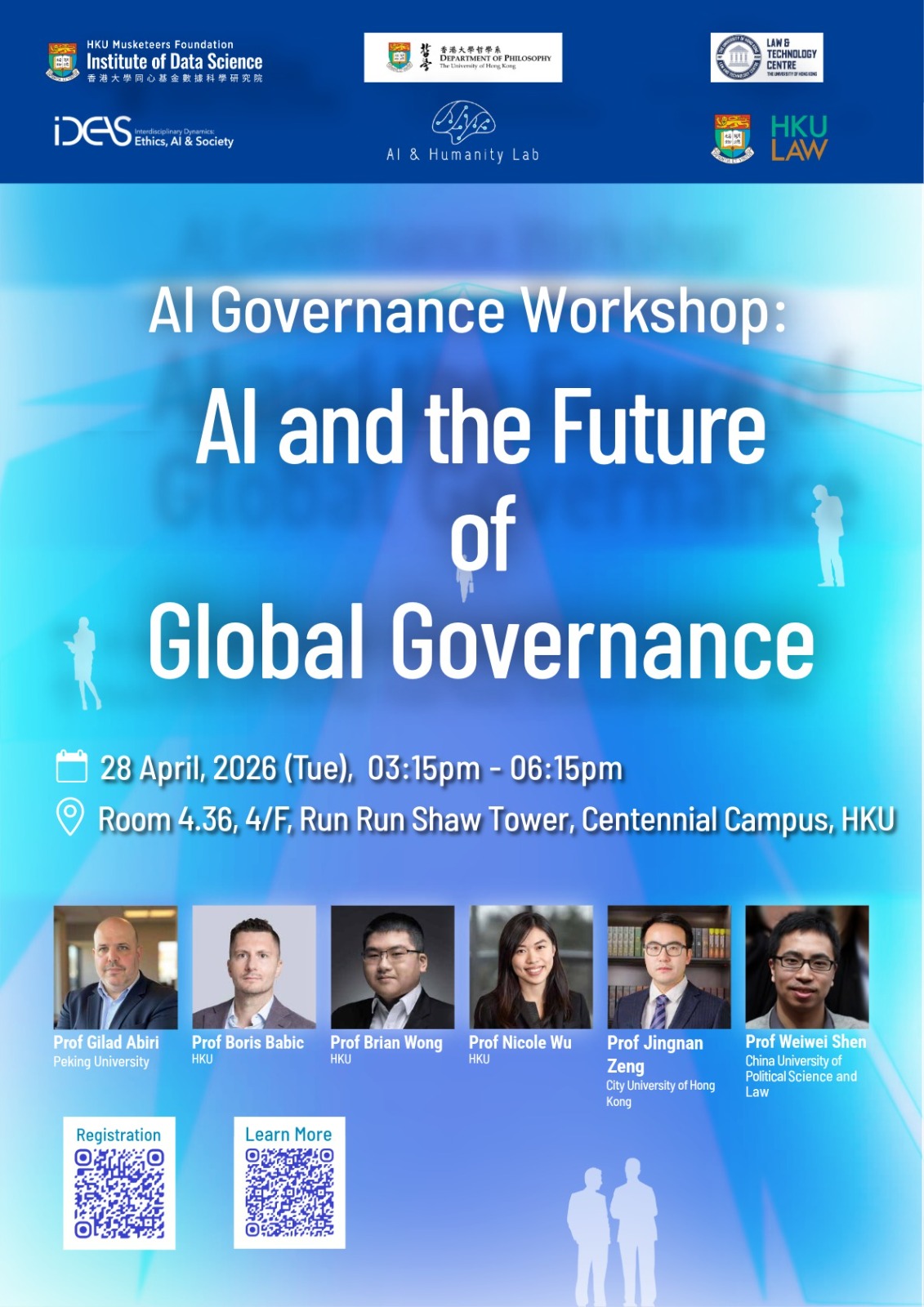
This workshop brings together scholars across philosophy, law, and international relations to examine how artificial intelligence is reshaping global governance. Discussions will explore the epistemic, behavioural, and geopolitical dimensions of AI, with a focus on how governance frameworks may need to evolve in response.
Date & Time
Tuesday, 28 April 2026
3:15–6:15 pmVenue
Room 4.36, 4/F, Run Run Shaw Tower,
Centennial Campus, HKU
Programme
|
Time
|
Programme
|
Speakers
|
||
|---|---|---|---|---|
|
15:15 - 15:25
|
|
|||
|
15:30 - 16:00
|
Epistemic Subordination
Prof Gilad Abiri, Peking University |
Abstract:
Generative AI does not merely produce biased outputs. It encodes the majority's way of knowing as the default infrastructure of knowledge itself. We call this epistemic subordination. The training process compresses the full breadth of human expression into a single probabilistic model whose statistical baseline reflects the languages, assumptions, and cultural frameworks of the dominant culture. Minority epistemologies are not excluded but absorbed — present in the training data, yet structurally subordinated in the output. The result is not a collection of discrete biases that can be audited and corrected. It is an epistemic condition embedded in the architecture from which all outputs emerge. This unified harm cuts across three legal domains — anti-discrimination law, cultural and linguistic rights, and democratic viewpoint pluralism — and each fails to address it for the same structural reason: existing law regulates downstream, at the level of decisions and applications. The remedy must match the site of harm. If epistemic subordination is produced at the level of model training, then law must learn to govern at that level. |
||
|
16:00 - 16:30
|
The Truth We Prompt: How User Partisanship Shapes AI interactions
Prof Nicole Wu, HKU |
Abstract:
The rapid rise of artificial intelligence (AI) is not only transforming societies but also redefining the very foundations of international relations. Around the world, governments are racing to secure technological leadership, framing AI as both an economic opportunity and a strategic imperative. China has declared its ambition to become an AI superpower by 2030, while the United States is equally determined to safeguard its global dominance. These competing trajectories have intensified the AI race, driving technological decoupling and placing U.S.–China relations at the heart of the struggle for global order. This talk will explore the complex interplay between AI and geopolitics. It will examine how the AI race is accelerating strategic rivalry, fuelling pressures for decoupling, and creating new fault lines in global governance. Beyond competition, it will consider how AI may reshape the balance of power, challenge existing international institutions, and ultimately reconfigure the future world order. By analyzing the opportunities and risks embedded in this technological revolution, the talk highlights why AI has become one of the defining forces shaping our collective future. |
||
|
16:30 - 16:45
|
Break
|
|
||
|
16:45 - 17:15
|
Prof Boris Babic, HKU & Prof Brian Wong, HKU
|
|
||
|
17:15 - 17:45
|
Prof Weiwei Shen, China University of Political Science and Law
|
|
||
|
17:45 - 18:15
|
AI, Geopolitics, and the Future World Order
Prof Jingnan Zeng, City University of Hong Kong |
Abstract:
The rapid rise of artificial intelligence (AI) is not only transforming societies but also redefining the very foundations of international relations. Around the world, governments are racing to secure technological leadership, framing AI as both an economic opportunity and a strategic imperative. China has declared its ambition to become an AI superpower by 2030, while the United States is equally determined to safeguard its global dominance. These competing trajectories have intensified the AI race, driving technological decoupling and placing U.S.–China relations at the heart of the struggle for global order. This talk will explore the complex interplay between AI and geopolitics. It will examine how the AI race is accelerating strategic rivalry, fuelling pressures for decoupling, and creating new fault lines in global governance. Beyond competition, it will consider how AI may reshape the balance of power, challenge existing international institutions, and ultimately reconfigure the future world order. By analyzing the opportunities and risks embedded in this technological revolution, the talk highlights why AI has become one of the defining forces shaping our collective future. |
||